
Manage the build, not the chat.
Bennch is the workspace for software built with AI. Your coding agent connects to it over MCP, builds from a clear plan of cards and reports back, so you can see what’s planned, what’s being built, what needs your decision and what’s actually been checked.
Your AI writes the code. Bennch shows what’s planned, what’s being built, what needs you and what’s been tested.
Live now with Claude Code. Codex and more coming soon.

Ledgerly, an example project in Bennch: the next step, what needs you and where the build stands.
AI writes the code. Bennch keeps the project on track.
Building fast is the easy part now. Knowing where the project stands is what gets hard.
The whole project, every session.
The plan, your decisions and design links live with the project, so a new session never starts from zero.
Your AI builds what you approved.
Extra ideas come back as proposals. Choices that are yours come back as questions.
Done means you’ve checked it.
Not when the AI says so. Each card shows its commits and tests, and only you can accept it.
Approve the cards. Your AI builds them in order.
Every piece of work is a card. Your AI takes them in order, in the same Claude Code session, and hands each one back with proof.
Up next 4
Your AI works down the list
Turn an accepted quote into an invoice
Attach photos of the finished job
Mark an invoice as paid in cash
Monthly income summary
Your AI is building 1
One at a time, in order
Today screen: jobs and unpaid invoices
iOSAndroid
2 commits so far
Tests passing
Next up: LD-24, in the same Claude Code session. Nothing for you to start.
Your check 2
Built. Only you can finish these
Sign in with an email link
iOSAndroid
4 commits · tests passed
Remind clients when an invoice is overdue
2 commits · tests passed
1You approve the cards
What each is for and how you’ll know it works. Unapproved cards can’t be started.
2Your AI builds them in a row
One card, or as many as you like. Your AI finishes one, starts the next, and only stops when something needs you.
3You check the proof
Try it on your own devices. A failed step goes back to its card with your note.
More than a task board.
The plan, the decisions, the code and the tests stay connected from the first card to launch.
A plan that covers the whole product.
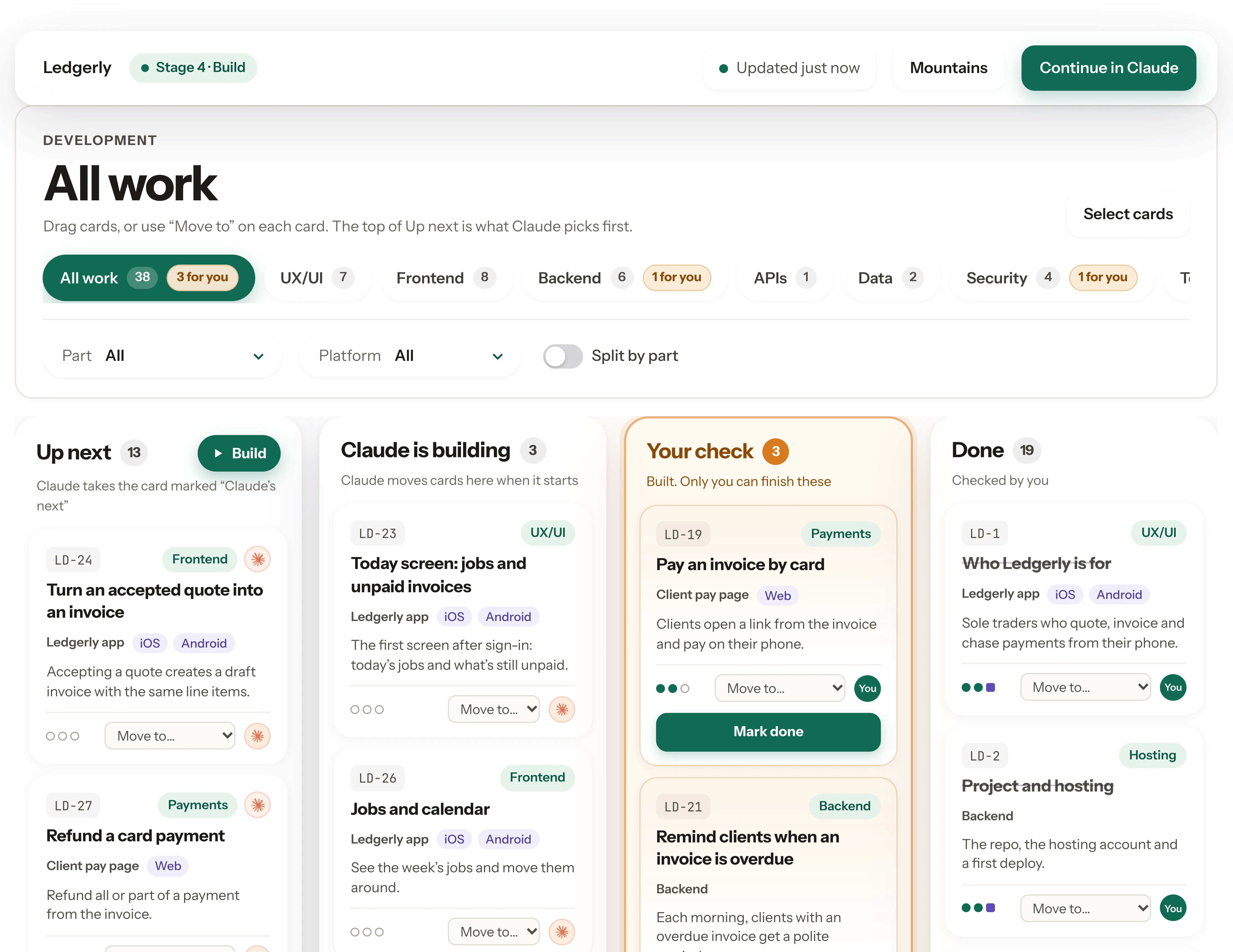
Take Ledgerly, an invoicing app for tradespeople. It has a phone app, a page where clients pay, and a backend. Each card belongs to one of those parts, sits on a board for its kind of work, such as design, backend or security, and says where it runs: iOS, Android or web.
See the whole product at once, or just the phone app’s next few cards, and have your AI work through them in order.
Every card belongs to a part of your product, sits on a board for its kind of work and says where it runs.
- Turn an accepted quote into an invoiceLedgerly app · iOS, Android
LD-24Frontend - Refund a card paymentClient pay page · Web
LD-27Payments - Keep invoices for six yearsBackend
LD-28Data

Decisions stay with the work.
When a choice is yours, such as how data is stored, payments or security, your AI asks with options and a suggestion instead of deciding. Answer in the chat or in Bennch.
Your answers stay on record for every later session, and cards link to where their designs live, like a Figma file.
When a choice is yours, your AI asks, with options and a suggestion. Your answer stays on record for every later session.
Pick up where you left off.
The Overview shows the next step and what’s waiting on you. If a session stops halfway, the next one picks that card up first. Run several AI sessions at once and each card shows which one is building it.
If a session stops halfway, the next one picks that card up first. Run several at once and see what each is doing.


Evidence attached to what was built.
Each card shows its commits, the tests the AI reported, your CI result and which platforms were covered. Work that grows far beyond its card is flagged.
Each card shows its commits and tests, and what hasn’t been tested yet.
The jobs only you can do.
Your AI can’t create your accounts, set up your server or add your API keys. When it needs one of those, it adds it to your To do list with short steps and shows which cards it’s holding up.
Once you’ve done it, your AI tests it where it can. Your keys stay out of Bennch.
Your AI lists what only you can do, like creating accounts or adding API keys, with short steps. Your keys stay out of Bennch.

Test it yourself, one step at a time.
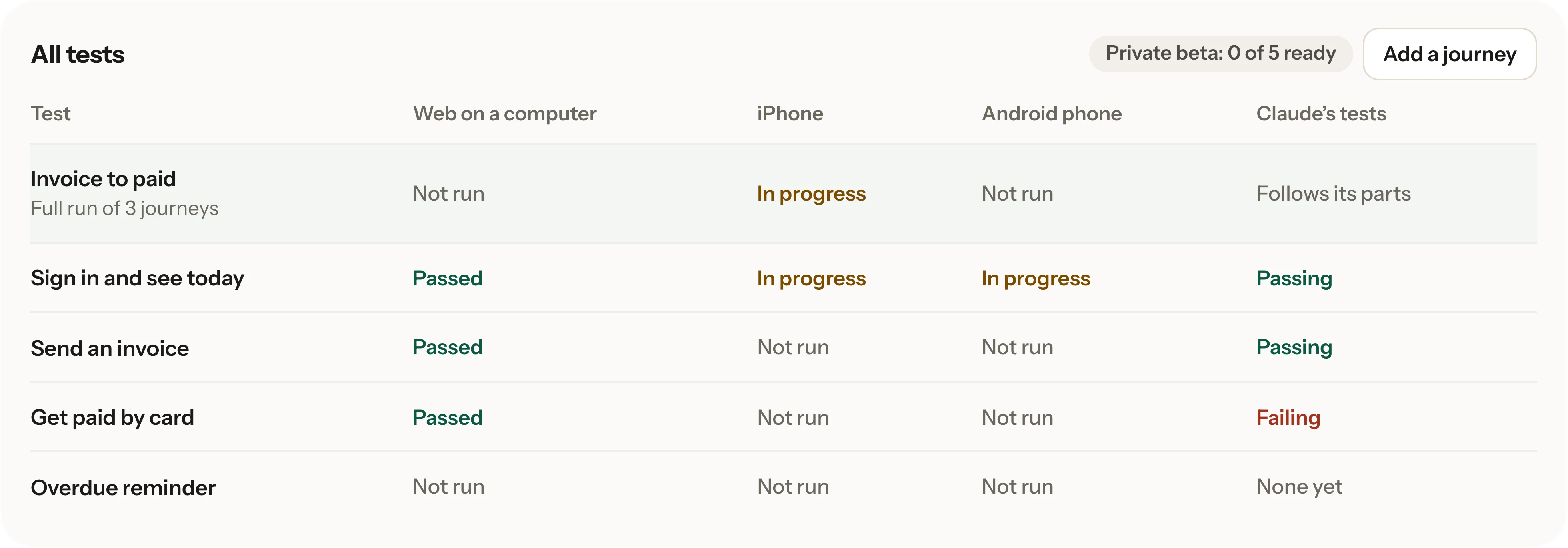
Each journey through your product gets a step-by-step guide, linked to the cards it covers. Follow it on your own computer or phone, and one run can accept several cards.
A step-by-step guide on your own computer and phone. One run can accept several cards.


1Open it where it really runs
Staging, Expo or TestFlight. Scan the code and it opens on your phone.
2Follow the steps
Each step says what to do, what you should see and which card it checks. A problem goes back to that card with your note.
3See what’s been tested
Every journey on every device, beside the results from your AI’s own tests.
Start from an idea, or from code you already have.
Tell Bennch which it is. An idea gets planned with you; existing code gets mapped: what’s built, and what’s left.
Plan it together
Your AI asks what you’re building, who it’s for and what the first version must do. It plays back a short brief, then proposes cards for you to approve.
Your AI: “What are we building?”
Map what’s there
Your AI reads the code and proposes cards for what’s built and what’s left. Built work comes to you to check in one go; new cards are only for what’s missing.
Your AI: “This folder has code, so I’ll map what’s built and what’s left.”
Up and running in a few minutes.
Join the waitlist
We’ll email your invite. A short practice project, about 20 minutes, shows you how it all works.
We’ll email your invite, with a short practice project to learn on.
Add Bennch to your AI
Add it as a custom connector in Claude (Customize → Connectors) with app.bennch.co.uk/mcp. It connects over MCP and covers all your projects. No keys to copy.
Add it as a custom connector in Claude with app.bennch.co.uk/mcp. No keys to copy.
Ask your AI to start
Paste the start prompt from Bennch. Your AI plans or maps the project with you; approve the cards, press Build, and it gets to work.
Paste the start prompt. Your AI plans your idea or maps your code, then you approve the cards.
What Bennch enforces.
- Bennch never stores your code
It keeps your plan and what your AI reports: commits, tests and results.
- Only you approve and accept
Your AI’s connection has no tool to approve cards or mark work done.
- Secrets are refused
Values that look like API keys or tokens are refused on cards, decisions and handovers.
- Approved work only
Bennch refuses to start a card you haven’t approved.
Bennch never stores your code
It keeps your plan and what your AI reports: commits, tests and results.
Only you approve and accept
Your AI’s connection has no tool to approve cards or mark work done.
Secrets are refused
Values that look like API keys or tokens are refused on cards, decisions and handovers.
Approved work only
Bennch refuses to start a card you haven’t approved.
Works with your tools.
- Claude CodeLive
Builds from your approved cards over MCP. Bennch runs no AI of its own.
- GitHubLive
Commits that name a card appear on it, with your Actions result. Read-only.
- CodexComing soon
The same cards and checks for OpenAI’s Codex.
- GitLab and SentryComing soon
Pipelines on each card, and new errors on the card that shipped them.
Claude CodeLive
Builds from your approved cards over MCP. Bennch runs no AI of its own.
GitHubLive
Commits that name a card appear on it, with your Actions result. Read-only.
CodexComing soon
The same cards and checks for OpenAI’s Codex.
GitLab and SentryComing soon
Pipelines on each card, and new errors on the card that shipped them.
Questions.
Which AI coding tools work with Bennch?
Claude Code works today, and Codex and other coding agents are coming. Your AI does the building; Bennch holds the plan, the decisions and the evidence.
Does Bennch run AI?
No. Everything the AI does happens in your own coding tool, under your own account.
Can Bennch stop the AI going off-plan?
Bennch blocks what goes through it: your AI can’t start an unapproved card, approve anything or mark work done. It can’t control what the AI writes in your files, so with GitHub connected, commits are linked to cards, unusually large changes are flagged, and nothing counts as done until it’s been checked.
Can my AI work through several cards?
Yes. Press Build, pick a board or part of the product, and choose one card or several in a row. You can also run several AI sessions at once.